
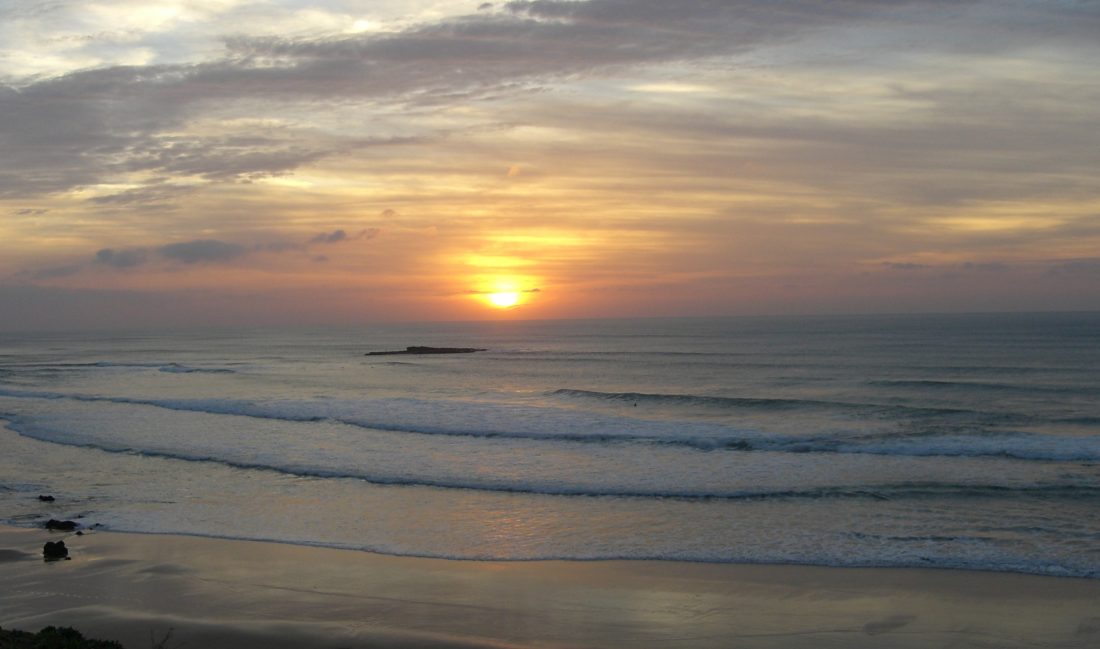
Last checked November 2026.
Since 2021 you can’t sleep in a campervan or motorhome on most of the Algarve coast unless you’re on a campsite or in an authorised motorhome area, and the police do check.
The Algarve region of Portugal is one of the most popular places in Europe for campervan and motorhome owners to visit, and for good reason. It has fantastic year-round weather, a stunning coastline, beautiful mountains, lots of history, and it isn’t too expensive either.
In summer it’s busy with every type of holidaymaker. In winter the resorts go quiet, and the visitors are mostly locals and the many campervans and motorhomes that come for the winter sun, staying on campsites and motorhome parks.
The Algarve has attracted more tourist development than the rest of Portugal put together. The coast between Faro and Lagos has been heavily built up, but there are still plenty of unspoilt landscapes and sandy beaches.
- The west coast: undeveloped bays and coves, quiet campsites and some of the best surfing in Europe, especially in winter.
- West of Faro: a series of small bays and coves, the most striking around Lagos and Albufeira.
- East of Faro: a chain of sandbar islands, the ilhas, runs along the coast almost to the Spanish border. This is the quieter, warmer-water side of the Algarve.
- Inland: the Roman ruins at Estoi, the Moorish town of Silves, and the Serra de Monchique, the highest mountains in the south.
Where you can and can’t stay overnight
Portugal changed its rules for campervans and motorhomes in 2021. The current law is Lei n.º 66/2021, in force since 25 August 2021, which amended article 50.º-A of the Highway Code (Código da Estrada). In short:
- “Overnighting” means being in the vehicle between 22:00 and 07:00. The law calls it pernoita.
- Protected areas: campsites and authorised areas only. Overnighting is banned in Natura 2000 sites, protected areas and the coastal zones covered by the coastal plans (the Planos de Ordenamento da Orla Costeira), except in places expressly authorised for it. That covers most of the Algarve coastline, including the whole west coast in the Costa Vicentina natural park and the Ria Formosa natural park east of Faro.
- Elsewhere: up to 48 hours in the same municipality, unless the local council has its own rules, and some Algarve councils do. The allowance is written for vehicles approved as motorhomes, so a van that isn’t registered as a motorhome may not be covered.
- Fines are €60 to €300, and €120 to €600 in the protected areas. You can pay on the spot, at the minimum amount.
- Parking isn’t camping. Putting out chairs, tables, an awning or steps, taking up more space than the van itself, or emptying grey or toilet water anywhere other than a proper disposal point is a separate offence, with a fine of €30 to €150.
- Daytime parking in ordinary car parks is generally fine, but in protected areas a motorhome may only park in places authorised for vehicles, and many beach car parks now have motorhome signs with time limits. Read the signs.
The GNR, the PSP, the Maritime Police and the councils all enforce the rules, and the Costa Vicentina sees regular checks. The beach car parks that used to fill with vans every winter are now checked at night.
The simple rule for the Algarve coast: plan every night on a campsite or in a motorhome area. There are plenty of them, listed below.
Campsites and motorhome areas

The Algarve’s licensed places to stay are campsites, rural camping parks and motorhome service areas (áreas de serviço para autocaravanas, or ASAs). The regional authority, CCDR Algarve, lists them in its RAARA network. Motorhome areas usually have water, waste disposal and often electricity, and many campsites offer long-stay winter rates.
From January to March the popular sites fill up with winter visitors, so book ahead. Opening dates and prices change, so check each one before you travel.
| Area | Campsites | Motorhome areas |
|---|---|---|
| West coast (Odeceixe to Vila do Bispo) | Camping Serrão (Aljezur) | ASA Odeceixe; ASA Francelho on Wheels (Aljezur); ASA Vento Norte (Vila do Bispo) |
| Sagres and Budens | Camping Orbitur Sagres; Salema Eco Camp (Budens) | |
| Luz and Lagos | Camping Turiscampo (Luz); Camping Orbitur Valverde (Lagos) | |
| Alvor, Portimão and Ferragudo | Camping Alvor; Parque de Campismo de Ferragudo | CampingCar Figueira (Portimão); ASA Ninho do Parchal (Parchal) |
| Armação de Pêra and Albufeira | Parque de Campismo de Armação de Pêra; Parque de Campismo Canelas; Camping Albufeira | Algarve Camping Car Park (Armação de Pêra); Algarve Motorhome Park Falésia (Olhos de Água) |
| Silves and around | Algarve Motorhome Park Silves; Parque do Castelo and Parque do Rio (Silves); Rancho Belchior (Algoz); Sulpark (Ferreiras) | |
| Faro and Olhão | Parque de Campismo Municipal de Faro; Parque de Campismo e Caravanismo de Olhão; Parque de Campismo da Fuseta | Faro Campervan Park |
| Tavira and Cabanas | Parque de Campismo Ria Formosa (Cabanas de Tavira) | Algarve Motorhome Park Tavira; Quinta da Eira Antiga (Tavira) |
| Manta Rota to the Spanish border | Parque de Campismo de Monte Gordo | Parque de Autocaravanas da Manta Rota; Parque de Autocaravanas da Muralha (Vila Real de Santo António); ASA Almada d’Ouro (Castro Marim) |
| Inland hills | Parque Rural do Vale da Carrasqueira (Monchique); Quinta de Odelouca (São Marcos da Serra) | Motorhome Ecopark and ASA Live on Wheels (São Brás de Alportel); ASAs at Salir, Ameixial, Alferce, Marmelete, São Marcos da Serra and São Bartolomeu de Messines |
Weather
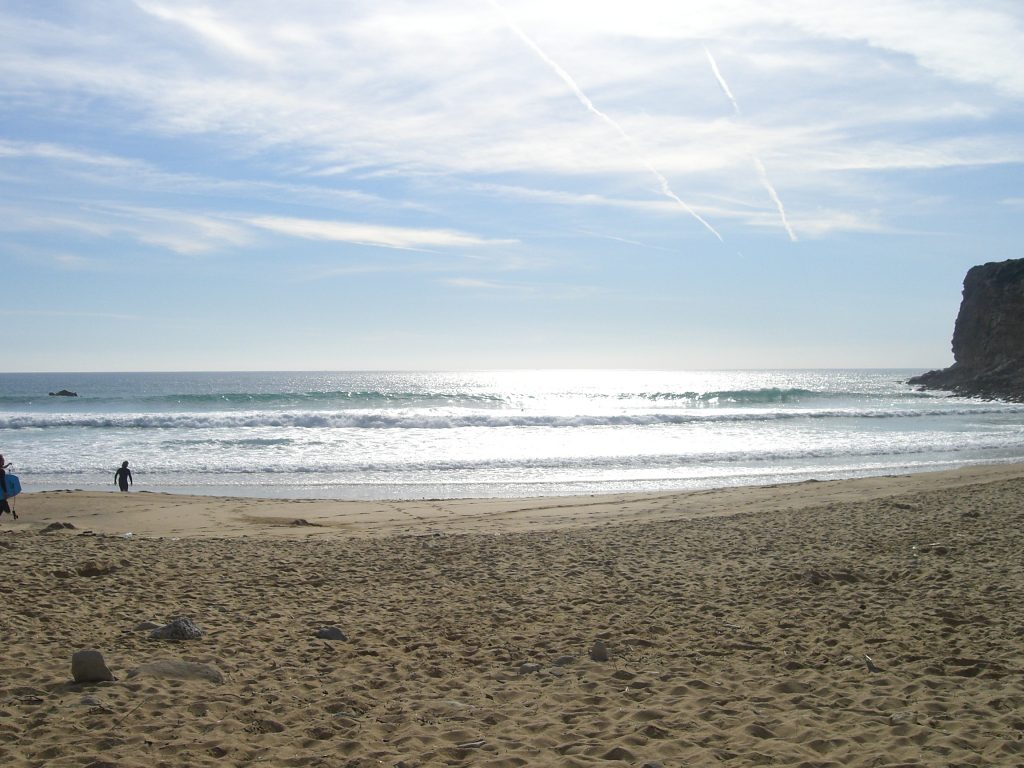
Spring and summer weather in the Algarve is very good: sunny and warm just about every day. Still days in summer can be very hot, though not as hot as inland places such as Seville, thanks to the reliable sea breeze.
Autumn is generally pleasant. Sunny days in the 20s are normal, with some cloudy days, but you won’t need to wrap up. Nights stay mild, and you typically won’t need the heater until after Christmas.
Winter can be cold, but on a still, cloudless day you could find yourself sunbathing. Expect a few light ground frosts and occasional rain. In winter the Algarve is one of the warmest places in Europe. See Winter in Europe.
Getting there and getting around
From the UK, most people either take a ferry to northern Spain and drive south, or cross the Channel and drive through France and Spain. See ferries and ferry or drive? to weigh up the options.
The A22 motorway (Via do Infante) runs the length of the Algarve from Lagos to the Spanish border, and it has been toll-free since 1 January 2025. Other Portuguese motorways, such as the A2 from Lisbon, still charge tolls. The old N125 runs parallel to the A22 through the towns; it’s slower but handy for short hops. See driving in Portugal and driving in Europe.
Before you go, check that your insurance and breakdown cover include Portugal for the whole length of your trip; some policies limit time abroad. See campervan insurance, or compare motorhome insurance quotes.
Fuel and gas
Fuel is usually cheaper in Spain than in Portugal, so it’s worth filling up before you cross the border. Prices vary between fuel stations, and the big supermarket stations are often cheapest.
Autogas is sold at many fuel stations in Portugal; look for GPL Auto. If you have a refillable gas system, carry the European adapter set. Portuguese gas bottles are on sale everywhere, as many homes use them, but you’ll need a Portuguese regulator. Camping Gaz exchanges are widely available. See gas bottles and camping and motorhome stores in Portugal.
Supermarkets
Intermarché, Pingo Doce, Continente, Lidl and Aldi are all common, and most towns have at least one. Smaller villages have a mini-mercado for bread, milk and water.
Geography and surfing
The Algarve has Portugal’s best beaches. The west coast takes the full force of the Atlantic winds and waves, but there are many beautiful rocky coves where the high cliffs give shelter. The south coast is more sheltered and has the best beaches for swimming.
There are great surfing beach breaks, reef breaks and point breaks on both coasts, and the west coast is one of the most consistent swell-receiving coasts in Europe. If Atlantic storms make the west coast unsurfable, the shelter of the south coast is a short drive away. There are plenty of surf schools.
Western Algarve: the Costa Vicentina
North to south. The whole west coast, from Odeceixe round to Burgau, is part of the Southwest Alentejo and Vicentine Coast Natural Park. Overnighting outside campsites and authorised areas is banned along all of it, and this is where the police check most often. Enjoy the beaches by day and stay at the places in the table above.
Odeceixe
A small village on the border with the Alentejo, with a lovely beach where the river meets the sea. Parking in the village is difficult, so use the car parks on the approach to the beach. Stay: ASA Odeceixe, or Camping Serrão at Aljezur.
Praia da Amoreira
A beautiful, secluded beach, quite a way from the main road. Stay: Camping Serrão or ASA Francelho on Wheels, both near Aljezur.
Praia de Monte Clérigo
A big beach in a beautiful setting, 5 km from the main road on a good but hilly road. Swimming and surfing are both possible, and there are a couple of cafés and restaurants by the car park.
The small lanes between Monte Clérigo and Arrifana are poorly signposted and not recommended. The main roads take about the same time and are a lot smoother.
Aljezur
An old Portuguese town that rewards time spent exploring it. There’s an Intermarché in town.
Camping Serrão, on the north side of Aljezur, is a campsite in quiet surroundings with a pool and a shop. All the pitches are among the trees, which give welcome shade in summer but can feel a little dark in winter.
Arrifana

Arrifana is a small cliff-top village of whitewashed cottages and holiday homes, overlooking a stunning little beach cove. A cobbled, steep, twisty road winds down to the beach; only small vehicles in good condition should tackle it. There’s a large parking area at the top, overlooking the bay, signed as no motorhomes, and a restaurant opposite. The café at the bottom of the road has amazing views over the beach.
Praia da Bordeira and Carrapateira

A big, exposed beach with gravel car parks near the cliff tops and lots of roads and paths to explore on foot or by bike. A wooden beach bar opens in summer, and the cliffs are popular with anglers. For surfers, Carrapateira picks up the most swell on the west coast and is the place to head on flat days. There’s a cliff-top restaurant between Carrapateira and Praia do Amado.
The village of Carrapateira has a mini-mercado selling the basics, including water, fresh bread and milk, and a couple of cafés. Stay: ASA Vento Norte at Vila do Bispo.
Praia do Amado

A lovely beach with high cliffs that shelter it from the wind, and one of the most popular surf beaches in the Algarve with locals and travelling surfers. There are two large car parks behind the beach and good paths for walking and cycling to Carrapateira. In the wild-camping days these car parks filled with vans every winter; overnighting here is now banned and checked. Stay: ASA Vento Norte at Vila do Bispo.
Praia da Cordoama and Praia do Castelejo
Two isolated beaches west of Vila do Bispo, reached by a rough road. Worth the drive for the scenery. Stay: ASA Vento Norte at Vila do Bispo.
Sagres

Sagres is less a resort than an old fishing village turning to tourism. The town has no sights of its own, but there are a few shops, a good choice of bars and restaurants, and many beautiful beaches around it. The Fortaleza and the lighthouse at Cabo de São Vicente are the things to see.
The big car park at the Fortaleza has views over Tonel beach to the west and Mareta to the east, and it’s a good spot to check the surf on both coasts. It’s fine by day, but not overnight. There’s a large Intermarché on the main road into town.
Camping Orbitur Sagres, on the road towards the lighthouse, has shaded pitches with small hedges, a shop and a bar, and it’s a nice area to relax. The bike ride out to the lighthouse is a good one.
Praia do Barranco

A beautiful, remote bay with a sandy beach and rocky edges, at the end of a 5.6 km rutted track that can be a problem in wet weather. When the conditions are right a right-hand wave peels from one side of the bay to the other, and surfers arrive in numbers. Barranco used to be a favourite long-stay spot for vans; it’s inside the natural park, so overnighting is now banned. To get there, take the turning off the N125 signed for Praia da Ingrina and Praia do Zavial.
Praia da Ingrina
A pretty beach with a restaurant and, in the right conditions, great surf. It’s signed from the N125, and the car parks are on the right as you near the beach. There’s a megalithic monument on the right of the road on the way in.
Praia do Zavial
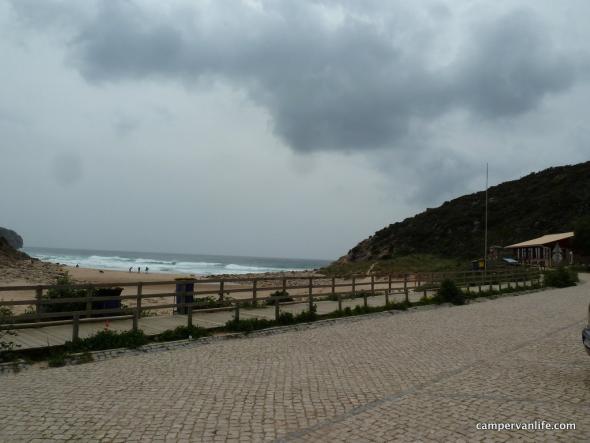
Carry on past Ingrina and you reach Zavial, a good surfing beach with a restaurant. Stay: Salema Eco Camp at Budens, or Camping Orbitur Sagres.
Praia da Salema

Salema is a pretty little village and a good place to escape the wind. There are public toilets in the square and a little supermarket opposite. The beach is good for swimming and can have good surfing waves in the right conditions. Stay: Salema Eco Camp at Budens.
Boca do Rio

“Mouth of the river” in Portuguese: a wide valley with a small beach and the ruins of an old fishing settlement. It used to be one of the busiest wild-camping spots in the Algarve, with as many as 50 motorhomes by the beach in winter. Overnighting is now banned and enforced, but it’s still a lovely place for a day, with good walks along the cliffs in either direction or up the valley. The hills to Salema and Burgau are very steep for cyclists.
Praia das Cabanas Velhas
A secluded beach with a summer beach bar and great surf in the right conditions. It can be difficult to find: from Burgau, drive west to the crossroads with the bus stop, where you’ll see a sign for Cabanas on one side of the road and Boca do Rio on the other. The road becomes a rough but sealed track, and after about 1 km you’ll see the lane to the beach.
South coast: Luz to Quarteira
Luz and Espiche

Luz is a pretty little resort that isn’t too hard on the eye, and a good place to escape the crowds of Lagos. The beach is great, with good surfing, and there are good bars and a supermarket on the main street. Daytime parking near the beach is fine; don’t stay overnight in the car parks or on the sea front, where residents and the police move vans on.
Camping Turiscampo, on the N125 between the two turnings for Luz at Espiche, is a big, well-equipped site with a pool, bar, restaurant and shop, popular for winter stays.
Camping Orbitur Valverde, just outside Luz, is a large campsite within easy reach of the beach. Walking and cycling are possible, but you’ll be on the edge of a fairly busy road.
Lagos
A lively town with a large Intermarché, a Pingo Doce on the way to Meia Praia and a Lidl behind the town. The car parks by Meia Praia, the marina and the railway station that once took vans overnight are no longer options. Stay: Camping Orbitur Valverde or Camping Turiscampo, a short drive west.
Alvor
A fishing village with a long beach and a lagoon, between Lagos and Portimão. Stay: Camping Alvor.
Praia da Rocha and Portimão
Praia da Rocha is the most popular beach in the Portimão area: a long sandy beach with plenty of beach bars and restaurants, very busy in summer and quiet the rest of the year. It’s a nice bike ride to Portimão along the river. The council aire by the marina, which once had room for hundreds of motorhomes, closed in 2017 for development. Stay: CampingCar Figueira (Portimão) or ASA Ninho do Parchal, across the river at Parchal.
Ferragudo
A nice little town on the east bank of the river opposite Portimão, with good restaurants around the main square. The sandy area by the river where vans used to stay is closed off and watched. Stay: Parque de Campismo de Ferragudo, or ASA Ninho do Parchal nearby.
Armação de Pêra
Armação de Pêra is still essentially a small Portuguese town, with tourism slowly taking over from fishing. It’s prettier and more authentic than many of its neighbours. The beach is large and good for families, with bars and restaurants right next to it, several open all year.
There are several places to stay: Parque de Campismo de Armação de Pêra, Parque de Campismo Canelas, about 2 km from town on the main road and an easy walk or cycle in, and the Algarve Camping Car Park for motorhomes.
Albufeira and Olhos de Água
The Algarve’s biggest resort, busy and built up, with a pretty old town above the beach. Stay: Camping Albufeira, or Algarve Motorhome Park Falésia at Olhos de Água, which is also the nearest motorhome area for Quarteira.
Eastern Algarve
The eastern Algarve is sheltered from the Atlantic winds and storms that hit the west, and it’s the warmest place to stay in Portugal in winter. From Faro to Manta Rota the coast is part of the Ria Formosa natural park, so the same rule applies: campsites and authorised areas only.
Faro
Faro is the region’s largest town and its capital. The coast east of here is protected by mud flats and sandbanks, and it’s generally less crowded than the rocky bays west of Faro.
Once a sleepy town, Faro is now a bustling centre with an attractive harbour, pedestrianised shopping streets and excellent beaches. The Great Earthquake of 1755 destroyed most of its historic buildings, leaving the Cidade Velha, the old town, across from the harbour. Praia de Faro, the main town beach, is a long sweep of sand with a sea-facing side and a more sheltered lagoon side, and ferries run through the marshy channels to the sandbar beaches. For food and drink, head for the pedestrianised streets around Rua de Santo António; almond sweets are the regional speciality.
Faro isn’t the easiest place to park. Smaller vehicles can try around the market, and larger vehicles near the harbour. Stay: Parque de Campismo Municipal de Faro at Praia de Faro, which is busy and cramped in summer, or Faro Campervan Park.
Olhão and Fuseta
Olhão is a working fishing town with a big waterfront market. Fuseta is a small village on the lagoon with a campsite right by the sea front, which can get very crowded. Stay: Parque de Campismo e Caravanismo de Olhão or Parque de Campismo da Fuseta.
Tavira and Santa Luzia
Tavira is one of the prettiest towns in the Algarve, built on both banks of the river Gilão. Santa Luzia, just along the lagoon, is a pretty village overlooking the river and sandbars, with excellent seafood restaurants; it’s a nice place to unwind with a drink and watch the boats. Stay: Algarve Motorhome Park Tavira or Quinta da Eira Antiga.
Cabanas de Tavira
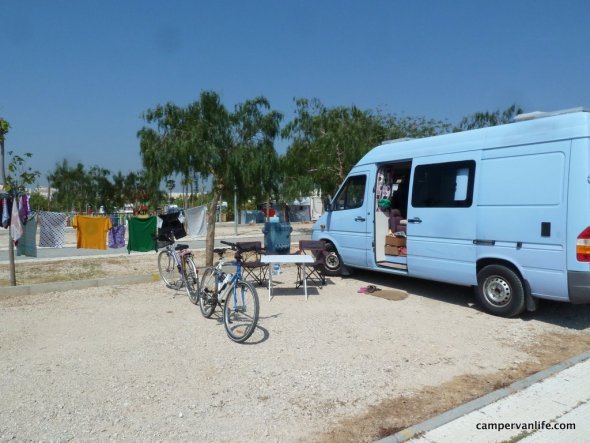
Cabanas is a nice little town with no beach of its own but summer ferries to the beautiful sandbar islands. There are shops and restaurants, and a great cycle path through the salt flats to Tavira. It was once a very popular wild-camping spot, until too many vans led to a complete ban.
Parque de Campismo Ria Formosa has open, hard-standing pitches, so it isn’t very private, but it’s a sociable campsite with a restaurant, bar, shop, pool and clean, modern facilities. It’s popular with long-stay campers and close to the cycle path to Tavira.
Manta Rota, Monte Gordo and Vila Real de Santo António
The last stretch before the Spanish border, with long sandy beaches backed by dunes. Stay: Parque de Autocaravanas da Manta Rota, Parque de Campismo de Monte Gordo, Parque de Autocaravanas da Muralha at Vila Real de Santo António, or ASA Almada d’Ouro near Castro Marim.
Inland Algarve
Inland, the Algarve is a different world of orange groves, cork oaks and quiet villages.
- Silves, the old Moorish capital, has a red sandstone castle and three motorhome areas: Algarve Motorhome Park Silves, Parque do Castelo and Parque do Rio.
- The Serra de Monchique, the highest hills in the south, is cooler and greener than the coast, with views from Fóia across the whole Algarve. It’s a Natura 2000 site, so stay at Parque Rural do Vale da Carrasqueira or the ASAs at Alferce and Marmelete.
- Estoi, north of Faro, has the Roman ruins of Milreu. The motorhome areas at São Brás de Alportel are close by.
- The Serra do Caldeirão villages of Salir and Ameixial each have an ASA, and are good bases for walking.
More on Portugal
- Portugal by campervan
- The Alentejo, the coast and plains to the north
- Lisbon
- Andalucía, across the border
- Winter in Europe
Sources: Lei n.º 66/2021, Diário da República, 24 August 2021; RAARA network list, CCDR Algarve; checked November 2026. Know of a change? Tell us in the comments below.
The Ferragudo wild camping site listed here is no longer available. Closure of another larger area nearby has focused local attention on it. Was only suitable for 4WD. Authorities monitoring daily!
.
January 2018, Western Algarve. There is quite a bit of police action due to the large number of wild campers, and really, a lot of them don’t care about making a mess, emptying chemical toilets wherever. Police turning up regularly and moving people on, issuing fines.
Praia da Rocha site now closed as it is now being developed as Villas.
Ferragudo area is still being visited by vans and some get away with it but the GNR/Maritime Police visit regularly and issue fines of up to 600 euros for wild camping here. Be careful.
Wild Camping
Hi all,
Myself and my girlfriend are just back from our 10 day trip around southern Portugal. While we were out there we used this website as reference, when we found free wifi, so I thought I would try and put the record straight as there is some comments that would put people off wild camping which I think is unfair.
Please note we were in the country from the 20th – 28th of September which is technically the end of the summer…but nobody told the sun 😉
PRAIA DE ODECEIXE
There is no camping signs down at the beach level side near the river, but people seemed to camper there fine. If you take the road that brings you to the village just above the village…I think you take the second exit from the roundabout before you hit the village there is an area that lots of campers set up which was completely fine and without signs.
Praia do Bordeira
As it says here the car park is totally fine to camp or you can take the dirty road further up the hill and maybe find a quieter spot (think Praia do Amado is also supposed to be fine for camping)
Boca da Rio
Has a new car park built and so won’t accommodate a large number of campers. We never stayed but it was recommended by the locals we met in Porto Covo. They said it is their usual go to spot.
Porto Covo
So Porto Covo has loads of options. The beaches (there is loads) are apparently a no for campers however there was loads camping at them. We stayed in the center of town for free. There is a large parking area near the hotel. There is water and public toilets that are locked at night.
Praia Forte Novo
This is a funny one. We arrived on out last night. There is loads of signs at this Praia saying there is no camping and sign showing how they are developing a huge car parking area where the campers would usually hang out. There was two campers there when we rocked up but decided not to chance it…being our last night. We drove further down the beach to Praia do Almargem where we found an AMAZING spot to camp, up in a car park above the sand dunes. Great views of the beach and a fantastic sunset, but for toilets you will have to go back to the restaurant at Forte Novo.
Anyway that was what we found with out trip. It does seem to be a lot more relaxed during that time of year so I wouldn’t be too broken hearted if you keep reading about how it is completely illegal and not tolerated…that just seems to be during the high seasons. 😉
Cheers,
Ian
campervan days over
Hello, just to say that free camping is illegal in Portugal.
A few years ago when it was quieter, the police were more tolerant and let the odd camper park up. Nowadays it is different. It has got busy and the police are fed up with all the human waste, toilet paper and rubbish in the bushes, beaches and roadsides that the camper vans leave behind.
The relaxed days of the 70s and 80s are past. The Algarve is cleaning up and wanting to attract a different type of tourist. Travelling campervans are not welcome in the wild unspoilt areas.
Many beaches are now closed to overnight camping with clear new signage.
The local people are unhappy about it as well, and campervans can expect to be reported if seen overnighting. The police will most likely move the vans on but can also fine on the spot.
There are good campsites provided at very good prices in Sagres, Figueira, Ingrina and Salema.
Best Camp Site in Algarve
Hello everyone,
I was browsing throught the internet and I found this great website. I have already been in Algarve, in fact you could say I am an Algarve Veterain Camper, for my experience, I say that Caliço Park is the best Camp site I have been since ever… I hope you fall in love with Caliço as I did.
Thank you for that great website,
Kind Regards,
Richard
camping
hi Richard, its my first time camping in Portugal always went to spain I am on my own and have campervan, do you no any clubs that are for singles ,just I would feel safer if there is other people the same as me.regards freda
Free Camper van sites West Algarve Horse ranch. Sea views
Camper van owners are invited to stay free!
We offer a few secluded sites with superb views on our historic hill farm with distant ocean views towards Cape St Vincent.
We offer horse riding, carriage driving facilities by the hour or day and gastonomy experiences from our Country Cooking School.
Our free sites are scattered around our 50 acre hill farm and do not have electrical or water hook ups, but you are welcome to use our stable shower and wc facilities. Well trained pets are also welcome. We located 2 kilometers down a good dirt road, off the N120 between Lagos and Aljezur.
Campervan
Hi David, I have a campervan rental company and I would like to know if you welcome my clients at your place. Thanks
Camping on Eastern Algarve
The carpark at Manta Rota is now manned and charged at €4 per night to motorhomes.
Further along at Vila Real di Santo Antonio(eastern end, near the Spanish border) the car park next to the ferry is now also manned / barrier and charged at €3 per night.
albufeira
There is a new site (ex football field) in Albufeira… http://www.parquedapalmeira.com
Lagos
There is now an official,campsite in the football stadium.
Camping in the Algarve
I would like to advise readers of this info that although the descriptions of our beautiful beaches are 100% accurate, camping on the beach is illegal in Portugal, and the Maritime Police will frequently visit beaches and move people on, especially during the summer months. I know because I have spent many a spoilt trip. Be warned, fines can be in excess of 500 euros, per camper.