
Last checked November 2026.
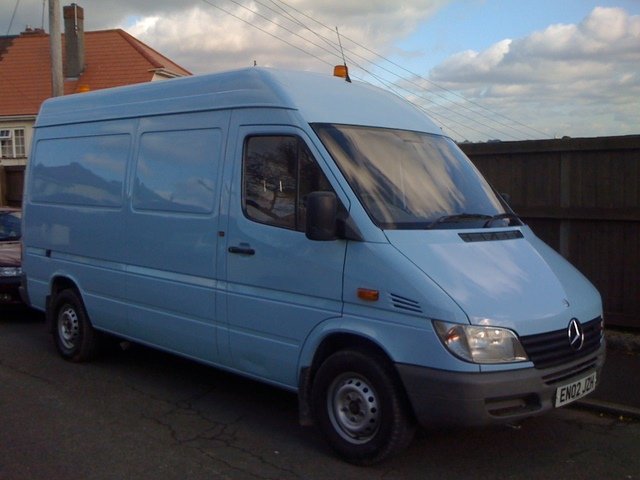
Ex-utility and other ex-fleet works vans, from gas and telecoms vans to council vans, have worked for a living, and they come with racking, a bulkhead and beacons that all have to come out. But if you can find one without too many work bruises on it, you can have a good vehicle for a campervan conversion. Darren’s own was a light blue ex-Transco gas van, a 2002 Mercedes Sprinter, bought in 2010 and turned into a camper.
Transco, National Grid and Cadent
Transco ran Britain’s gas pipes: the national transmission system and the regional distribution networks. The company started life as British Gas plc at privatisation in 1986, and Companies House records its names since then:
| Dates | Company name |
|---|---|
| 1986 to 1997 | British Gas plc |
| 1997 to 1999 | BG plc, after Centrica, the new company for the businesses trading as British Gas, was demerged |
| 1999 to 2000 | BG Transco plc |
| 2000 to 2005 | Transco plc, part of Lattice Group, and of National Grid Transco from October 2002 |
| 2005 to 2023 | National Grid Gas plc |
| 2023 on | National Gas Transmission plc, which owns and runs the national transmission system |
Transco plc became National Grid Gas plc in October 2005, so any van bought new by Transco is now more than 20 years old. The local gas networks have moved on too. In 2005 National Grid sold the Scotland and South of England networks to Scotia Gas Network (now SGN), the North of England network to Northern Gas Networks, and the Wales and the West network to Wales & West Utilities. It kept the North West, East of England, West Midlands and London networks until 2017, when it sold a majority stake and they became Cadent. Today’s gas network vans are run by these four companies.
Darren’s ex-Transco Sprinter
In February 2010 Darren was looking online for a high-top Mercedes Sprinter, VW LT or LDV Convoy, ideally newer than 2000 and with less than 100,000 miles. One stood out at a van dealer in Cornwall: a blue, ex-Transco, 2002 medium-wheelbase high-top Sprinter with a full service history, a brand new MOT and 96,000 miles, for £3,000. It had a few bruises, as all work vans do, but it was in good condition.
Darren had lived for 9 months in a short-wheelbase medium-top Sprinter that was too low to stand up in fully, so this time a proper high-top was essential, and the little extra length of a medium wheelbase was well worth the trade-off in parking and slightly worse fuel economy. This was a phase 2 Sprinter, and its 110 bhp turbocharged engine made it a lot quicker than the old 80 bhp van.
From April 2010 the van was Darren’s only vehicle. It fitted in a supermarket parking space and was rarely a problem, though just occasionally Darren went round in circles looking for a space, and the high top kept it out of car parks with height barriers. With no rear windows it was tricky to see behind when reversing, so Darren fitted reversing sensors.
Readers have done the same. In 2014 Liam and Claire Hart, after their last VW T4, turned an ex-Transco Ford Transit into a baby blue, beach hut themed camper with 3 beds, a kitchenette and loads of room.
What a works van comes with
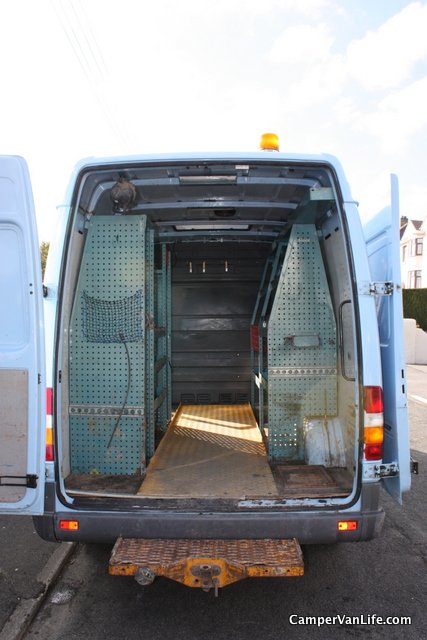
Darren’s van came with full racking, a bulkhead, a yellow track along the floor, a rear step, roof beacons and internal strip lights, with plastic lining inside and ply lining on the floor. Other ex-Transco vans also had spotlights. Cadent, which runs four of Britain’s eight regional gas networks, said in June 2025 that all of its roughly 3,000 vehicles have racking installed, and that a large portion of its large panel vans have PTO (power take-off) systems.
Some vans have extra electrics. In 2012 a reader’s ex-Transco Sprinter had an extra battery, a generator underneath, 110 V sockets and a fan heater in the back, and the reader couldn’t get any power to the sockets. Have an auto electrician check any work electrics before you rely on them, or take them out. More on conversion electrics.
Stripping it out
None of the work kit is needed in a camper, so the first job is to get it out. Darren sold most of it, mainly so that it would be reused rather than scrapped, but also to make a few pounds: in 2010 the racking fetched £30 on eBay and the bulkhead £10, and the floor track went with the racking. The plastic lining went to a friend for a lightweight VW T4 conversion, and the internal lights were kept for reuse.
How it all comes out, from Darren’s notes:
- Bulkhead: riveted in with steel rivets. It’s best removed by drilling off the rivet heads, which gets difficult near the bottom, where there isn’t much room.
- Racking: bolted to brackets, so it just unbolts. Some of the brackets are riveted to the plastic lining and some to the van structure.
- Yellow floor track: heavy and difficult to remove, with bolts that pass right through to the underside.
- Rear step: bolted to the chassis with many very big bolts, which on Darren’s van had corroded and made it a challenge.
- Roof beacons: each bolted through the roof with 3 small bolts.
- Spotlights: the brackets are riveted to the van structure.
- Internal strip lights: screwed to the roof structure.
Every bolt through the roof or floor leaves a hole to seal. By April 2010 Darren’s van was stripped out, and the roof cleared of lights and aerials. The ply floor was very well fixed down, and what Darren could see of the floor and the lower part of the van was very clean, so it stayed down, though Darren agreed with a reader that lifting it to check for rust would give peace of mind.
Don’t keep the amber beacons. The lighting regulations allow amber warning beacons only on certain vehicles, such as breakdown vehicles and vehicles used to inspect, maintain or install apparatus in, on, under or over a road, and a camper isn’t one of them. More on tools and parts and insulation and lining.
Livery and paint
Darren’s van had no stripes or stickers, and no marks where any had been, but on other ex-Transco vans Darren could see where stripes had been removed. Some sellers take the livery off first: when Derbyshire Dales District Council appointed an auction house to sell its fleet vehicles in 2025, the job included removing decals, livery and signage. If you repaint a van a different colour, you must update the colour on the log book (V5C) with DVLA.
The ex-Transco vans Darren came across, Mercedes, Ford and Renault, were all the same light blue, which Darren thought made a nice change from the standard white. On Darren’s van the whole vehicle, inside and out, was the same colour, so the paint looked to have been done at the factory. It isn’t a standard colour, and Darren found it listed as:
JDU British Gas Light Blue (svo) 95- LRC.633
It’s listed under British Gas because the company that became Transco plc was British Gas plc until 1997. Darren also saw the colour code listed as C42, possibly a Renault code, and a decode of the VIN plate of an ex-Transco Sprinter gave the colour as 5559 light blue.
To touch up the paint you’ll almost certainly need some mixed. In 2010 Darren’s local Halfords couldn’t find the colour under any of these codes, but a local motor paint supplier had it on their computer, and mixed 2 aerosols without needing to see the van. The supplier suggested white primer as the best colour to use underneath, but said grey is easier to apply and just needs an extra coat of blue; Darren went with grey. The blue paint also needs a coat of lacquer.
Speed limiters
By law, speed limiters are needed on goods vehicles with a maximum laden weight over 3.5 tonnes and on vehicles with more than 8 passenger seats, but some fleets fit them to smaller vans too. In a road safety case study from about 2010, British Gas said it had decided in 2006 to limit all its new vans to 70 mph, with the whole fleet fitted by mid 2010, and that its vans carried a 70 mph sticker on the rear doors. If a works van won’t go any faster than about 70 mph, ask the seller whether a limiter is fitted.
Where to buy one
Darren found the Sprinter by searching online for vans in the area, and bought it from a local van dealer. Councils can hire an auction house to sell their old vans. NEPO, a public sector buying organisation, runs a framework from February 2025 to January 2029 under which public bodies can choose one of seven auction houses to collect, prepare and sell their vehicles and plant, at online and physical auctions: Aston Barclay, BPI Auctions, Brightwells, Commercial Vehicle Auctions, John Pye, Merthyr Tydfil Car Auctions and Wilsons Auctions. Through it, in January 2025, Derbyshire Dales District Council appointed Commercial Vehicle Auctions, in Doncaster, to value and auction its fleet vehicles. The pros and cons of buying from dealers, at auction and privately are in buying a base van.
Before you buy
- MOT history: the free MOT history on gov.uk shows each result, the mileage at each test, what failed and any minor problems, for van tests since 2005. Check the mileage adds up, and look for repeated rust items.
- Recalls: check the registration on gov.uk for safety recalls that haven’t been checked or fixed, or search by make, model and year. The manufacturer does recall work, and you won’t usually have to pay.
- Emissions: to drive in London’s ULEZ, England’s Clean Air Zones or Scotland’s low emission zones without paying a charge or penalty, a diesel needs to meet Euro 6. Transport for London says Euro 6 became compulsory for new light vans in September 2015 and for larger vans up to 3.5 tonnes in September 2016, so no diesel old enough to have worked for Transco meets it. The log book may show the Euro standard (section D.2); if it doesn’t, check the registration on TfL’s vehicle checker. In November 2026 a van up to 3.5 tonnes that doesn’t meet the standard pays £12.50 a day in London’s ULEZ, and the Clean Air Zones in Bath, Birmingham, Bradford, Bristol, Sheffield and Tyneside charge vans too.
- Weight and licence: check the weight plate. If you passed your car test on or after 1 January 1997, a car (category B) licence covers vehicles up to 3,500 kg; since 10 June 2025 it also covers zero-emission (electric or hydrogen) vans up to 4,250 kg, but hybrids don’t count. Anything heavier needs category C1. Fleets now run electric vans too: in June 2025 Cadent’s included small and large electric panel vans.
- Service history: ask for it. Darren’s van came with a full service history.
Darren’s posts on the ex-Transco Sprinter
- It’s decided, another camper is coming (2010)
- Looking at vans (2010)
- Bought a new van (2010)
- Blue Mercedes Sprinter MWB (2010), stripping out the Transco kit
- Bought a reversing sensor kit (2010)
- Car is gone, van only now (2010)
More on base vans and conversions
- Buying a base van and choosing a base vehicle
- Mercedes Sprinter, Mercedes vans, Ford Transit and other panel vans
- Legal information for conversions
- Insulation and lining and electrics
- Campervan insurance
Sources: Companies House (National Gas Transmission plc and Cadent Gas Limited); National Gas, history of the gas industry; Cadent Gas annual report 2016/17 and Cadent’s June 2025 accident management notice on Find a Tender; NEPO; Derbyshire Dales District Council contract award on Contracts Finder (January 2025); British Gas road safety case study (Driving for Better Business); Road Vehicles Lighting Regulations 1989; gov.uk (speed limits, MOT history, vehicle recalls, driving licence categories, changing vehicle details on a V5C, Clean Air Zones); Transport for London; mygov.scot; checked November 2026. Know of a change? Tell us in the comments below.
Transco Camper Van
We’ve ditched VWs after our last T4 and decided to buy an ex Transco van which is now our baby blue camper van, complete with 3 beds, kitchenette and lots of homely finishing touches. Its definitely shabby chic as we’re on a budget but we are chuffed to bits with our beach hut themed Transit camper. There’s loads of room, storage space and our VW friends are jealous! We’re currently trying to find the original blue exterior paint so we can touch it up. Happy days! 🙂
Ex – Transco Mercedes Sprinter – Gorvenor Team
Hi,
I’ve purchased a ex Transco van that I’m unable to get the 110V power system to work in back of van. It’s the van with the extra battery and extra generator underneath. It has no PTO like lots of vans. I can turn the unit on and control engine revs with the control unit however there is no power available at the 110V sockets and the fan heater in back has no power. It’s a Geewhiz fuse board 2 x 16A 1 x 32A. Is there an isolation switch somewhere on the van? There is a 10mm hole LHS of steering wheel in dash like there was a switch there and found a wire behind there but bridging doesn’t make it work, it’s a 4 core wire. Any advice on getting it working would be much appreciated. My email is [email removed]
Thank you and kind regards
David