
Last checked November 2026.
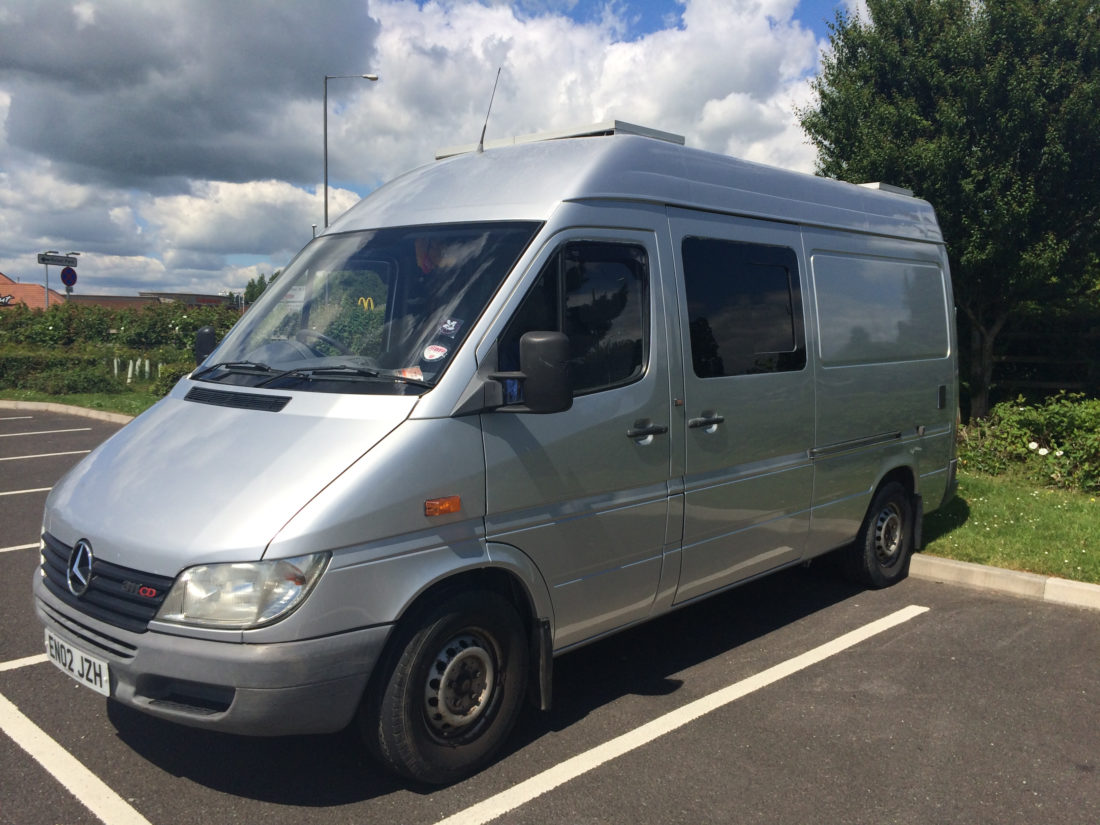
Mercedes-Benz has been making vans for a very long time: Mercedes traces its vans back to 1896, when Carl Benz built the first Benz delivery van. The Mercedes Sprinter is one of the most popular panel vans for camper van conversions and motorhomes, and Mercedes says that in 2025 one in ten Sprinters sold worldwide went to a motorhome customer. Darren’s two camper vans were both Sprinters, chosen for their reliability and build quality: the first, a 1995 208D, had done 180,000 miles and still drove very well. Whatever the model, a good example is worth paying for.
Mercedes Sprinter (1995 to now)
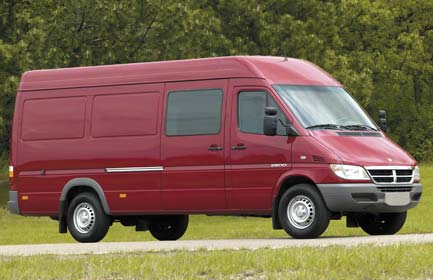 The Mercedes Sprinter is a workhorse van that comes in a range of sizes and power options, and it’s a great option for a panel van conversion. It’s so popular with businesses that there are lots of used ones about, and parts are easy to find all over Europe. The Sprinter replaced the flat-nosed T1 van, and there have been three generations:
- First generation (1995 to 2006). Launched in spring 1995 with a standard or high roof, and ABS brakes as standard.
- Second generation (2006 to 2018). Launched early in 2006 with three wheelbases, four lengths, three roof heights and weights from 3 to 5 tonnes, and stability control (ESP) as standard on vans up to 3.5 tonnes. A 5.5-tonne version followed in 2016.
- Third generation (2018 on). Front-wheel drive was added as an option alongside rear- and all-wheel drive; Mercedes says it gives an 80 mm lower loading sill, which makes getting in and out of a camper’s living area easier. Updated versions went on sale in January 2024.
The first electric eSprinter went into production at the end of 2019, with front-wheel drive. The current eSprinter, on sale since January 2024, has its motor on the rear axle and much bigger batteries.
The Sprinter has a step at the side door and full engine access through the bonnet, both great improvements on the T1. The rear doors open sideways, with or without windows, and with the right hinges and catches they open right back against the sides of the van; on today’s panel vans that’s standard. The later first-generation vans have CDI diesel engines with more electronics and a gear lever on the dashboard; the early ones, like Darren’s 208D, are much simpler.
Inside, the Sprinter is a little narrower than some big vans, which matters if you want a bed across the back. Mercedes gives the current one a load area 1,787 mm wide at its widest and 1,350 mm between the wheel arches, while Toyota gives its Proace Max 1,870 mm.
There’s no low-roof Sprinter, only the standard roof (which Darren calls a medium-top) and the high roof. For a low van, the Mercedes answer is the Vito.
Sprinters are known by a three-figure number: the first figure gives the weight class and the last two roughly the engine power. In the 2026 range a 315 is a 3.5-tonne van with 150 hp and a 417 is 3.88 tonnes with 170 hp; Darren’s 208D had an 80 bhp engine.
The minibus and passenger versions are a good option for a conversion too, as they already have lots of windows, and those count towards the 2 or more windows on one side that DVLA looks for if you want the log book changed to motor caravan. A car licence covers up to 8 passenger seats; a minibus with more needs category D1.
The Sprinter has a VW twin. The second-generation VW LT, launched in 1996, came from a development partnership between VW and Daimler-Benz and is identical in design to the Sprinter, though VW built it in Hanover. The first VW Crafter, launched in 2006, was also built in co-operation with Daimler.
Darren’s Sprinters
In 2006 Darren wanted a diesel, no older than 1995, that was tall enough to almost stand up in; a VW T4 and a Mercedes Vito were both too low. Darren bought a 1995 short-wheelbase Sprinter 208D with about 180,000 miles on the clock from a dealer in Plymouth for £1,000, gave it a good service, and lived in it for 9 months in France, Spain and Portugal. It was a medium-top that Darren couldn’t stand up in fully. At its next MOT, in 2007, it needed a headlight and two front suspension arms, no doubt worn by the endless rough Spanish and Portuguese roads.
For the next conversion, in 2010, Darren stuck with a Sprinter, this time a 2002 medium-wheelbase high-top: an ex-Transco gas van with a full service history and 96,000 miles, for £3,000. After 9 months in the medium-top, a proper high-top was essential, and the extra length of a medium wheelbase was well worth the trade-off in parking and slightly worse fuel economy. Its 110 bhp turbocharged engine made it a lot quicker than the old 80 bhp 208D.
Sprinter and eSprinter panel vans in 2026
Mercedes-Benz UK’s July 2026 price lists give these figures:
| New panel van | Sprinter (diesel) | eSprinter (electric) |
|---|---|---|
| Lengths | L2 5,932 mm, L3 6,967 mm, L4 7,367 mm | L2 5,932 mm, L3 7,124 mm |
| Roofs | High roof, about 2.6 to 2.7 m tall and 2,009 mm high inside; standard roof on the L2 only | High roof, about 2.72 m tall and 2,009 mm high inside |
| Power | 2.0-litre diesel, 150, 170 or 190 hp; 6-speed manual or 9-speed automatic; rear-wheel drive, or all-wheel drive on the 190 hp models | 81 or 113 kWh battery; 100 or 150 kW motor; rear-wheel drive; range 161 to 272 miles (Mercedes’ preliminary WLTP figures) |
| Maximum weight | 3,500 kg (3-series), 3,880 kg (4-series), 5,000 or 5,500 kg (5-series) | 3,500 kg (3-series), 4,150 or 4,250 kg (4-series) |
| List price, July 2026 | From £50,510 plus VAT (£60,612 with VAT), for a 315 L2 high roof | From £58,850 plus VAT (£70,620 with VAT), for an 81 kWh 314 L3 |
List prices don’t include delivery or options. Mercedes points out that real electric range depends on things like the load, the weather, your driving style and accessories fitted after registration, and a conversion adds to all of those.
Mercedes TN & T1 (1977 to 1995)
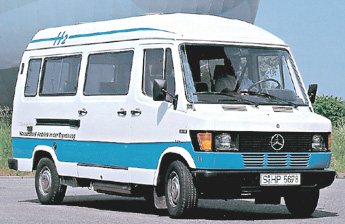 Mercedes presented the T1, known as the “Bremen van”, in 1977, and the Sprinter replaced it in 1995. The Mercedes TN and T1 vans are also affectionately known as the “pig nose”, because of the flat, pig-like nose. A very popular van, with many people using them as the base of their camper van conversion: Mercedes says it came in 252 variants, around 945,000 were built, and it was “the camper base for a generation”. It lacks a step at the side door, which the Sprinter has. Engine access is difficult, with some through the bonnet and the rest from under the dashboard.
Mercedes Vito (1995 to now)
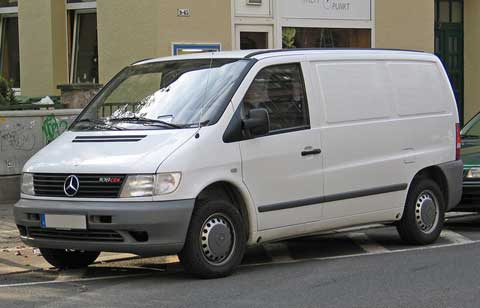 The Mercedes Vito is a popular medium-sized van, comfortable and stylish, and much the same size as a VW Transporter: today’s Vito is 5.14 or 5.37 m long, and the current Transporter 5.05 or 5.45 m. Like the Transporter it’s too low to stand up in, which is why Darren ruled one out in 2006; a pop-top roof is the usual answer.
- First generation (1995 to 2003). Front-wheel drive, and at 1.89 m tall it fitted into nearly any car park.
- Second generation (2003 to 2014). Rear-wheel drive, with all-wheel drive available, three lengths and two roof heights.
- Third generation (2014 on). Updated in 2020 with newer diesel engines. The electric eVito followed in 2018.
The passenger version was called the V-Class from 1996, the Viano from 2003 to 2014, and the V-Class again since then. Mercedes’ own camper version, the Marco Polo, dates from 1996, and in August 2026 Mercedes said the new Marco Polo would be built entirely in-house for the first time.
In July 2026 Mercedes-Benz UK listed the electric eVito panel van (5.14 or 5.37 m long, about 1.93 m tall, 3,200 kg, with a WLTP range of 159 to 160 miles) from £48,775 plus VAT (£58,530 with VAT), and the diesel Vito Tourer people carrier, about 1.91 m tall, from £46,720 plus VAT (£56,064 with VAT).
Mercedes T2
 A larger format van than the T1. Mercedes launched the T2 in 1967, known as the “Düsseldorf van” after the factory that built it, and made it for almost 30 years. The second series, from 1986, came at 3.5 to 7.5 tonnes, with three wheelbases and optional all-wheel drive, until the Vario replaced it. Many T2s weigh more than 3,500 kg, so check the weight plate against your licence.
Mercedes MB100D
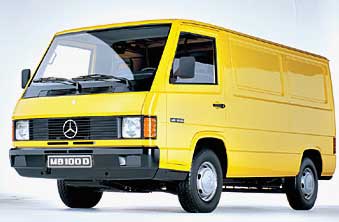 Curiously, the MB100 was never sold new in the UK: the trade magazine Commercial Motor reported in 1995 that it couldn’t be converted to right-hand drive, so expect any you find to be left-hand drive. Mercedes dates it from 1987, in versions from panel vans to motorhomes, and it was superseded by the Vito in 1995.
Mercedes 406D, 407D and 508D
 A large bus-format vehicle, many with a handy hinged side door. The classic “traveller” bus, and some are still on the road around Europe. These are the first series of the T2: Daimler’s own history says the L 406 D and the petrol L 408 were launched in January 1967, the 406 D became the L 407 D when it got a bigger 2.4-litre engine in 1974, a long-wheelbase L 508 D followed, and the first series was built in Düsseldorf until 1986, at 3,490, 4,000 or 4,600 kg. Expect high mileage, and check the weight plate against your licence.
Mercedes parts
Most serviceable parts are available at a good price. Because so many Mercedes vans were sold, there are plenty of good quality parts from other makers as well as genuine Mercedes ones: at the Pampy Camper’s 2007 MOT, the garage could get a pattern headlight for £75, against £150 for a Mercedes part.
Mercedes changed its recommended gearbox oil for the first Sprinters, so if you don’t know which oil is in the gearbox, change it rather than topping it up, as Darren did in 2006.
Driving licence and weight
If you passed your car test on or after 1 January 1997, category B covers petrol and diesel vehicles up to 3,500 kg maximum authorised mass (MAM), and electric or hydrogen ones up to 4,250 kg. Above that you need C1, which drivers who passed before 1997 normally have. Hybrids count as petrol or diesel. The weight plate is usually under the bonnet.
So a diesel 3-series Sprinter at 3,500 kg is fine on a car licence, but a 417 at 3,880 kg or a 5-tonne Sprinter needs C1, and so do many T2s. Since 10 June 2025, a car licence in Great Britain covers zero-emission vans up to 4,250 kg MAM with no extra training, so the 4,150 kg and 4,250 kg eSprinters can be driven on a car licence. Northern Ireland followed on 1 August 2026, for drivers who have held their licence for 2 years.
Batteries are heavy, and the weight comes out of the payload. Mercedes’ UK figures give an 81 kWh eSprinter L3 a weight of 2,998 kg with driver, against 2,488 kg for a diesel Sprinter of the same length, so at 3,500 kg the electric one can carry only 502 kg, against 1,012 kg for the diesel. Plated at 4,250 kg, the same eSprinter can carry 1,229 kg. More in choosing a base vehicle.
Buying a used Mercedes van
- MOT history. Check it free on gov.uk with the registration number. For vans it shows every test since 2005: whether it passed, the mileage, what failed and any minor problems noted, so you can see whether the mileage adds up.
- Safety recalls. Check the DVSA’s free recall checker on gov.uk, using the make, model and year of manufacture, for recalls that haven’t been fixed. You won’t usually have to pay for repairs or parts under a safety recall.
- Rust. Look underneath, along the sills, wheel arches, floor and door bottoms, and around any holes left by roof racks, beacons or racking.
- Servicing. A full or mostly complete service history is a good sign. Ask whether the engine has a timing belt (cambelt) and when it was last changed; the maker’s service schedule gives the interval.
- Suspension. Rough roads take their toll: a year on rough Spanish and Portuguese roads cost Darren’s Sprinter two front suspension arms.
- Ex-fleet and works vans. Darren’s ex-Transco Sprinter came with a full service history, but the racking, bulkhead and rear step all had to come out, and the step was held on by big, badly corroded bolts. See using an ex-Transco or other works van.
- A converted van. Check how it’s registered (van or motor caravan) and get insurance quotes on that. More in choosing and buying a camper van.
Clean air zones and ULEZ
To drive in London’s ULEZ, England’s Clean Air Zones or Scotland’s low emission zones without paying, a diesel needs to meet Euro 6. Diesel vans sold new from September 2016 should, but check the log book or DVLA’s free vehicle enquiry service rather than relying on the year. None of the older Mercedes vans, from the 406D to the first-generation Sprinters and Vitos, meets it.
- London: a non-compliant van or motor caravan up to 3.5 tonnes pays £12.50 a day in the ULEZ. Heavier vans come under the separate Low Emission Zone, which charges £100 a day, or £300 for the oldest, if they don’t meet Euro VI.
- England: Bath, Bradford, Sheffield and Tyneside charge vans but not cars, and Birmingham and Bristol charge both. How a campervan is classed depends on its type and weight, so check the registration on the government’s vehicle checker.
- Scotland: Aberdeen, Dundee, Edinburgh and Glasgow city centres have no daily charge: a non-compliant vehicle is fined £60 (£30 if paid within 14 days), doubling each time within 90 days, up to £480 for cars and vans. Vehicles over 30 years old are only exempt if they’re kept in their original state, which a converted van may not be.
- Old vans: a vehicle built before 1 January 1986 can be taxed in the historic class, which is free, and vehicles over 40 years old in the historic tax class are exempt from the ULEZ and England’s Clean Air Zones.
- Abroad: French low emission zones need a Crit’Air sticker, and some Spanish cities make you register a UK vehicle online first. See driving in France and driving in Spain.
Darren’s vans
- Camper van conversion (2006), the plan
- Bought a Mercedes Sprinter 208D van (2006)
- Engine service and drive home (2006)
- Transmission and exhaust (2006)
- MOT work required (2007)
- Mercedes Sprinter conversion: the Pampy Camper, including why Darren chose a Sprinter
- It’s decided, another camper is coming (2010)
- Bought a new van (2010)
- Blue Mercedes Sprinter MWB (2010)
More on vans
- Mercedes Sprinter, Mercedes TN and T1 and Mercedes Vito
- Fiat Ducato and VW Transporter
- Panel vans
- Choosing a base vehicle for a conversion
- Buying a base van
- Choosing and buying a camper van or motorhome
- Legal information for conversions
Sources: Mercedes-Benz UK price lists for the Sprinter, eSprinter, eVito and Vito Tourer (July 2026); Mercedes-Benz press releases (2018, 2020, January 2024, the Sprinter’s 30th anniversary in 2025, and August 2026); Mercedes-Benz Vans’ history of its vans (Ireland); Daimler’s history of the T2; Volkswagen Group chronicle; Toyota UK; Commercial Motor (October 1995); gov.uk (driving licence categories, electric and hydrogen vehicles, MOT history, vehicle recalls, Clean Air Zones, historic vehicles); Motor Vehicles (Driving Licences) (Amendment) (No. 2) Regulations 2025; Department for Infrastructure (Northern Ireland); Transport for London; mygov.scot; checked November 2026. Know of a change? Tell us in the comments below.
tyres for 406
Hi, does anyone know what size tyres are legal for a Mercedes 406D van 1980, any advice welcome!
Are you after the size to get
Are you after the size to get a replacement?
Perhaps a local tyre shop can help?
Nice article! Thanks for
Nice article! Thanks for adding these Mercedes models. I am sure most of us don’t know about these models by Mercedes, even I did not know of all these. Mercedes Benz is the best model as I think. There are various models of diesel cars manufactured by this company. Glad to know so much info about Mercedes Sprinter. I am also having this brand. Really these cars are just too good on road and perform much better than others but maintenance is quite essential for it. europeanmotorcarsalpharetta.com (no longer online)
You can find Mercedes maintenance here. Thanks for sharing.
Mercedes 507d
Hi folks, Just bought a Merc 507d double cabin pickup and Im looking for a workshop manual, in English! any ideas anyone? good summer travelling folks!
2002 sprinter
Hi, I’m looking for side opening windows for the above sprinter, either in the side opening door, or the opposite side beside the rear seat row. Can you sdvise please?
Thanks, Nigel, Stacey’s Motors
Hi
Try
Hi
Try http://www.leisurevehiclewindows.co.uk/
They have the best range and prices of all window types
Karman MB100D, 1989, LHD, 2500cc Diesel, 51k, km
Hi, A Karman MB100D has turned up in Northern Ireland with one owner.Originated in Finland, 1989, 51k, LHD in good nick. what sort of money would this be worth and any bad habits to look for. I need to act quick. A quick reply would be appreciated. Regards, Roy Kane
engine change on a mercedes l407d
hi i have a mercedes l407d that has now broken down in a big way i am after some engine parts or a complete engine maybe change the engine for a larger size has anybody got any helpful advice or spares please,
buy a cheap rusty iveco and
buy a cheap rusty iveco and take the engine ,gearbox, transmision and the back wheels from it
why the back wheels? I am
why the back wheels? I am looking at converting my 508D towards having an iveco motor in it. If you know of any online documentation, please tell me where I can find it